

Showcase 2025: Challenges in E-textile for Bio-Potential Monitoring
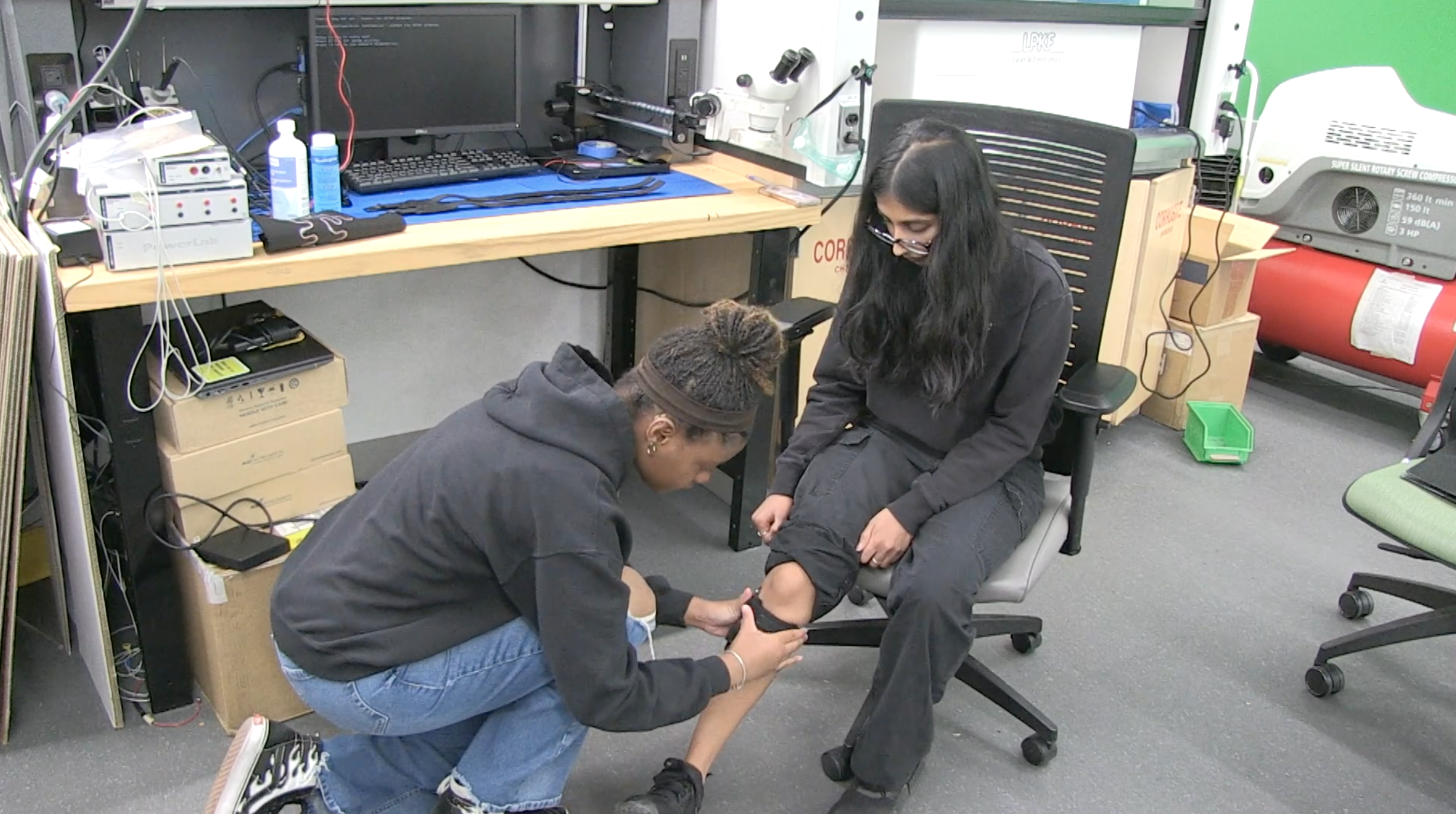
Smart fabrics took centre stage at Showcases 2025, where Maryam Davoudpour, PhD, and her students demonstrated how technology and design intersect in the next generation of wearable devices.
During the session, Davoudpour’s team presented an array of E-textile projects from the electronics prototype lab. E-textiles are fabrics embedded with electronic components that can monitor bio-potential signals generated by the body.
“Our students are very talented, and they bring different ideas,” said Davoudpour, a professor in the Faculty of Applied Science and Technology, noting that sharing their work gives students a sense of pride.
“They were so excited about presenting, just showcasing what they learned. Students can gain some self-confidence, which is very important,” she said.
In the last five years, the electronic and mechatronic departments have hired over 30 students and worked with six industry partners. These projects provide students with hands-on experiences that will prepare them for real-world challenges.
Sonya Patel, an Electronics Engineering Technology student, worked on a device to help with muscle monitoring and stimulation for ICU patients.
“The part that excites me the most is that I’m able to combine both electronics and biomedical sciences together,” said Patel. “I wanted to do something behind the scenes where you can create something that helps people.”
Salvador Estrada Ramos, a Mechatronics Engineering student, worked on a project to develop a wearable to detect sleep apnea.
“When I first stepped into the sleep lab, at that moment, I was like, ‘OK, this is serious,’ he said. “What we are building here at Humber, at the lab, is something that can make an impact in people’s lives.”
All video interviews were conducted and edited by Fiona Tudor Price.